
Alexander Grabovetskiy, woodcarver, School of Woodcarving · Published 2022
What wood did Grinling Gibbons carve in?
Quick answer: Grinling Gibbons' carving wood is limewood, with oak used for the background boards behind it. I said so in class 10 of my Maine course, the day I planned a darker ground for our own panel. Limewood is the British name. In America its close cousin is sold as basswood, a different species of the same genus.
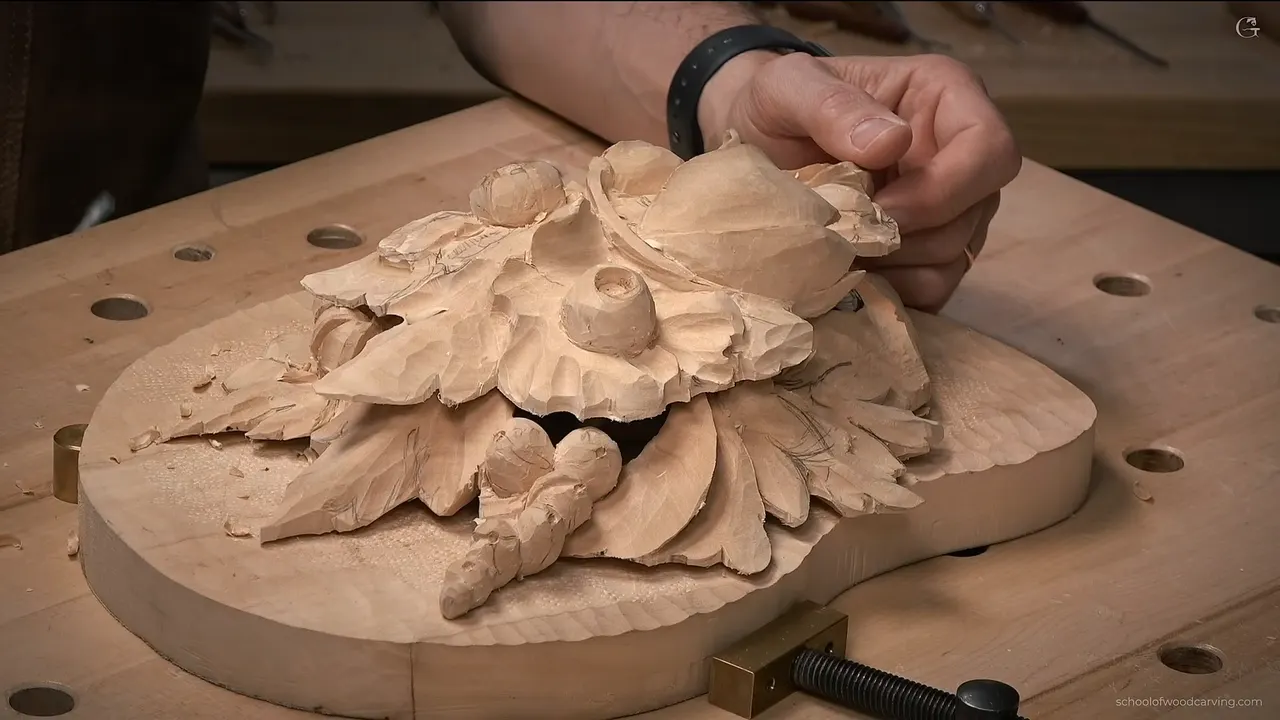
Limewood is the wood Grinling Gibbons carved, and oak was the board he set behind it. That's what I told you in class 10 of my Maine course, while I was choosing which number 11 to pick up. First I told you my plan for the panel we carved in Maine. Take those two carved layers out of their background and put on some kind of darker one, because that is what Gibbons did. His carving was limewood and his background was oak.
Want the short answer? You just read it. Want the long one, with the American name for limewood and the reason oak went behind it? I've talked about both woods on camera in more courses than this one, and below you get my own words from each, with the place I said them.
Limewood and oak in six lines
- Gibbons carved in limewood and set his work on oak, I said in class 10.
- In the USA it goes by basswood.
- Before him, wood carvers in England carved just oak, as I tell the story.
- Gibbons left his limewood bare, without wax or shellac, as I tell it.
- On our panel one spot of the pale board went almost translucent, a sign that more digging meant a big mistake.
- I put ours on walnut.
Which wood was Grinling Gibbons known for?
Limewood. Let me tell you a story, the way I told it in Venice Room 52. Before he came to England with his carving skills, the carvers there used only oak, pretty much English brown oak, which is beautiful wood. I carved some of it, and I love it. He brought them limewood. That wood was common in Europe, in Germany even in the 15th and 16th century, and I have a book about those limewood carvers. One of them was the famous Tilman Riemenschneider.
England had the trees, I said, and it still grows right there. People just didn't see how beautiful this wood is, and he was pretty much first to carve it in England.
On an antique style rosette I put it by cost. In England the cheaper carvings were done in pine, the more expensive ones in oak at the beginning, and after the 17th century, limewood. He brought that idea over from old Europe, I said. Holland, to be exact. In Germany the church carvings of the 15th and 16th century were limewood, and if you go to those old churches, or to the palaces in England, you'll be surprised how nice and fresh it looks.
I put it more carefully on the dining table apron, with a piece of oak on my bench. I believe the first person who introduced limewood to England was Grinling Gibbons, I said there. In Venice Room 77 I said the extra handles I leave on a piece, so I can flip it, are a trick Gibbons used. And how do I know it? I really don't know, I said. I'm just reading some books, and the people who wrote those books can only guess.
The written record says it plainer. Wikipedia puts most of his work in lime wood, especially Baroque garlands of still life things at about life size, and calls Riemenschneider a master in limewood and stone.
Is limewood the same as basswood?
Close enough for me. In that same lesson I went round the map. If you are in the USA, it is basswood. In Great Britain that wood would be limewood, in Germany linden wood, in Russia lipa. But that's pretty much the same wood, I said.
Botanists are fussier. Wikipedia's Tilia page puts every one of these trees in one genus, Tilia, called lime in Britain and linden or basswood in North America. American basswood is Tilia americana. The small leaved lime native to Britain is Tilia cordata, a different species, so they are close cousins. The same page says the name basswood comes from bast, the inner bark.
In a lesson on sandpaper, burnishing with the same species of wood, American basswood in my case, I said it's pretty much the same as European linden or European lime wood.
Why limewood for the flowers and not oak?
You can do a lot more with limewood than with oak. That's how I said it on the dining table apron, with oak under my gouge at the time. Oak is more crunchy, and it has a lot of grain. Even the sound is different, absolutely different, a more crunchy sound from the oak.
I'm going to be honest with you. I love English oak, the true brown oak, and it's probably one of my favorite oaks. Go to old churches in England and you'll find beautiful carvings, all done in oak.
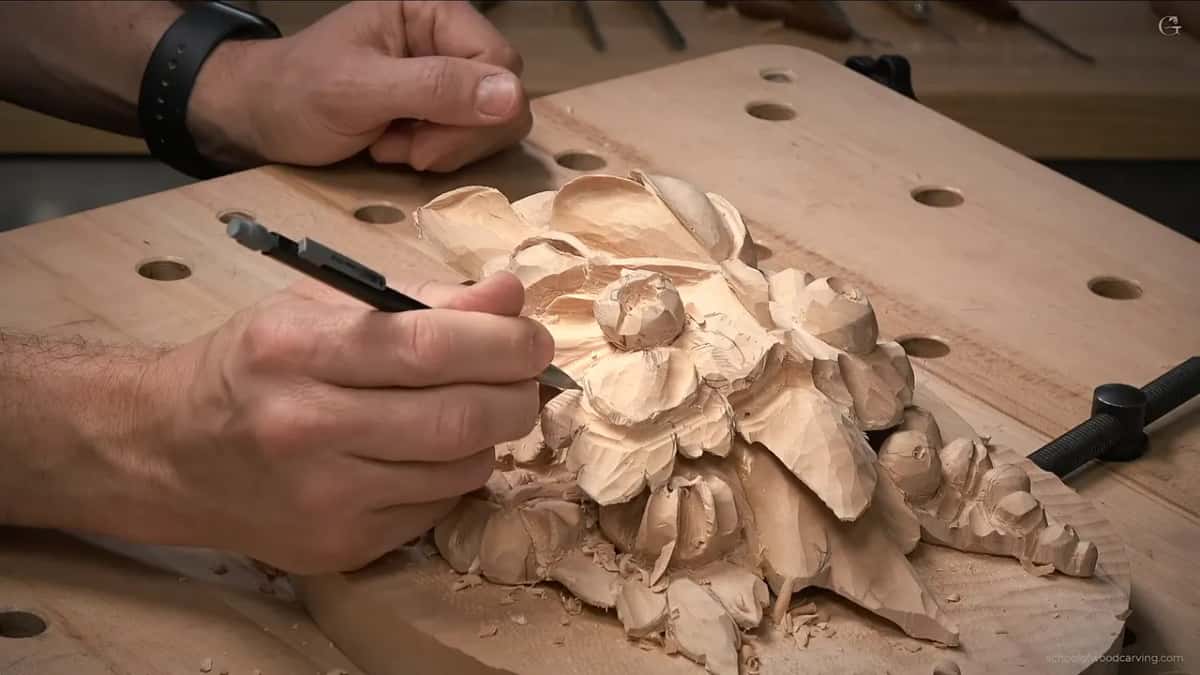
Limewood gives you room. There's almost no limit to what you can do with limewood or basswood, I said on that rosette. The material is soft enough, but still stable. In Venice Room 52 I also said it carves easily and it holds form. I call it the queen of woods there. It's not the best for furniture you use every day, but for big pieces, or even for a hobby, there's no better wood than that.
Soft or hard? I've called it both. Carving a flower rosette, I said basswood or limewood is a soft wood, and it just digs really nicely. Yet on the antique rosette I said old European culture didn't count it a soft wood at all. It was a hardwood, and a soft wood would be pine.
Botany lets both stand. Wikipedia defines hardwood as wood from flowering trees and softwood as wood from conifers, which is why balsa counts as a hardwood though it's softer than most softwoods.
Why did he put oak behind the carving?
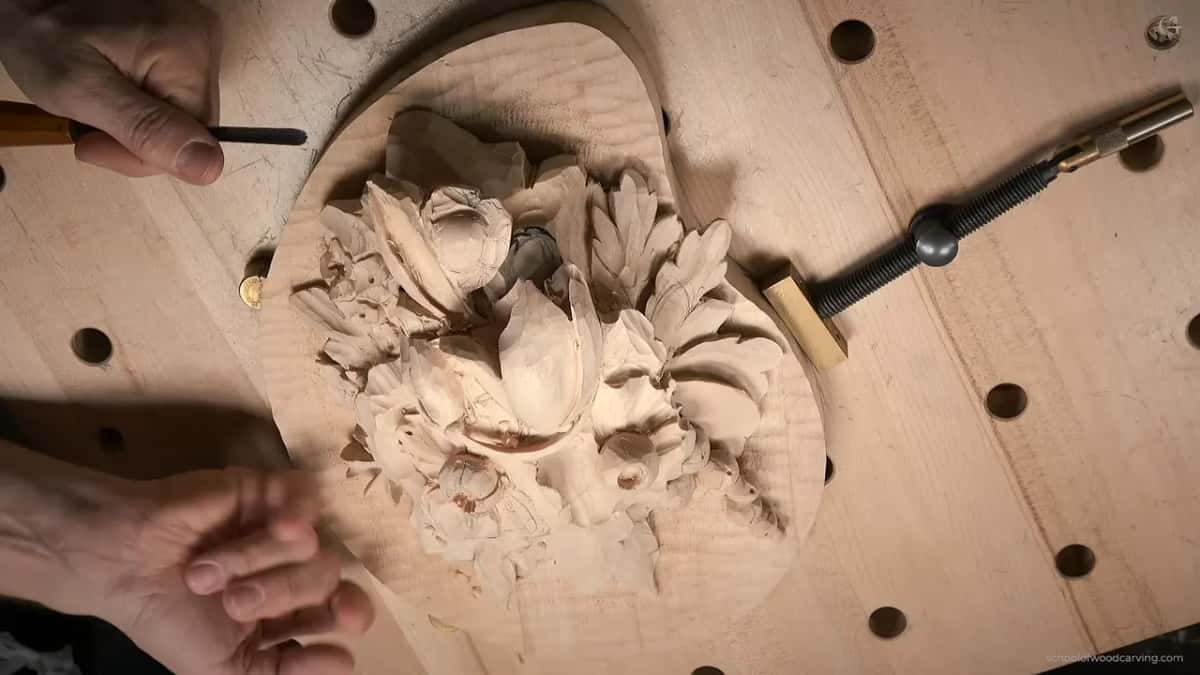
For a darker background. In class 10 that was my plan for our panel, the two carved layers taken off and set on something darker, the way he did it. Carving a Byzantine acanthus, I said you could use a different species of wood for the background, a darker wood, like oak or cherry. Grinling Gibbons used oak backgrounds all the time for his carving, I said.
The Maine panel went on walnut. By class 17 I said I had decided to use walnut as a background, while he would use oak, English brown oak. The darker wood gives that contrast. It exaggerates all of those excavated areas.
Why I picked walnut over oak comes up in class 11. The books I learned his woods from come up on the class 1 page.
| Wood | Said | Where |
|---|---|---|
| Limewood, for carving | Almost no limit on what it does | Antique rosette |
| Oak, in England | More crunchy, with a lot of grain | Dining apron |
| Basswood, in America | About the same as European linden wood | Sandpaper lesson |
| Oak, behind Gibbons | He used oak backgrounds all the time | Byzantine acanthus |
| Walnut, behind ours | Gives contrast and exaggerates the excavated areas | Maine 17 |
What did the pale wood of our panel do in class 10?
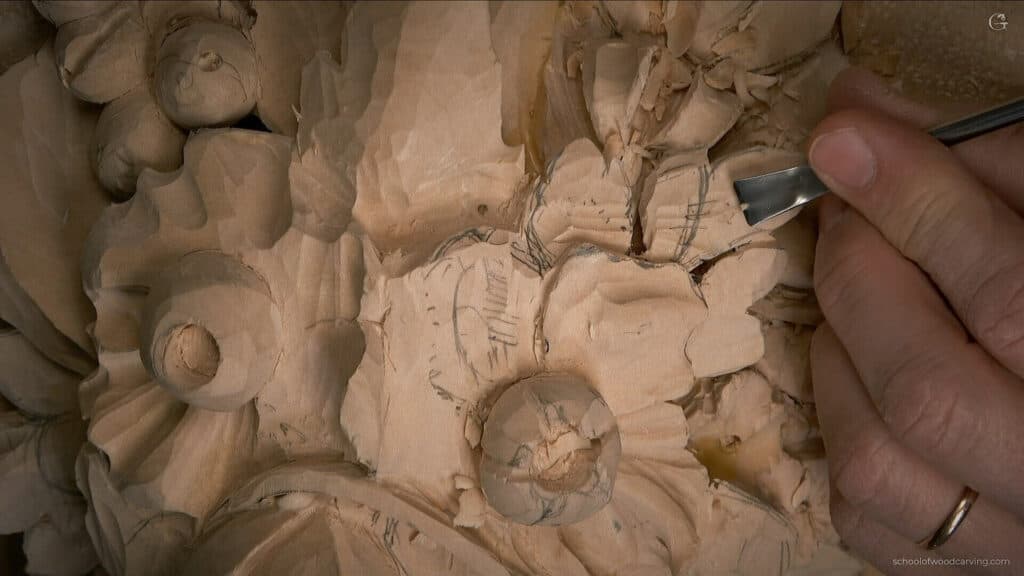
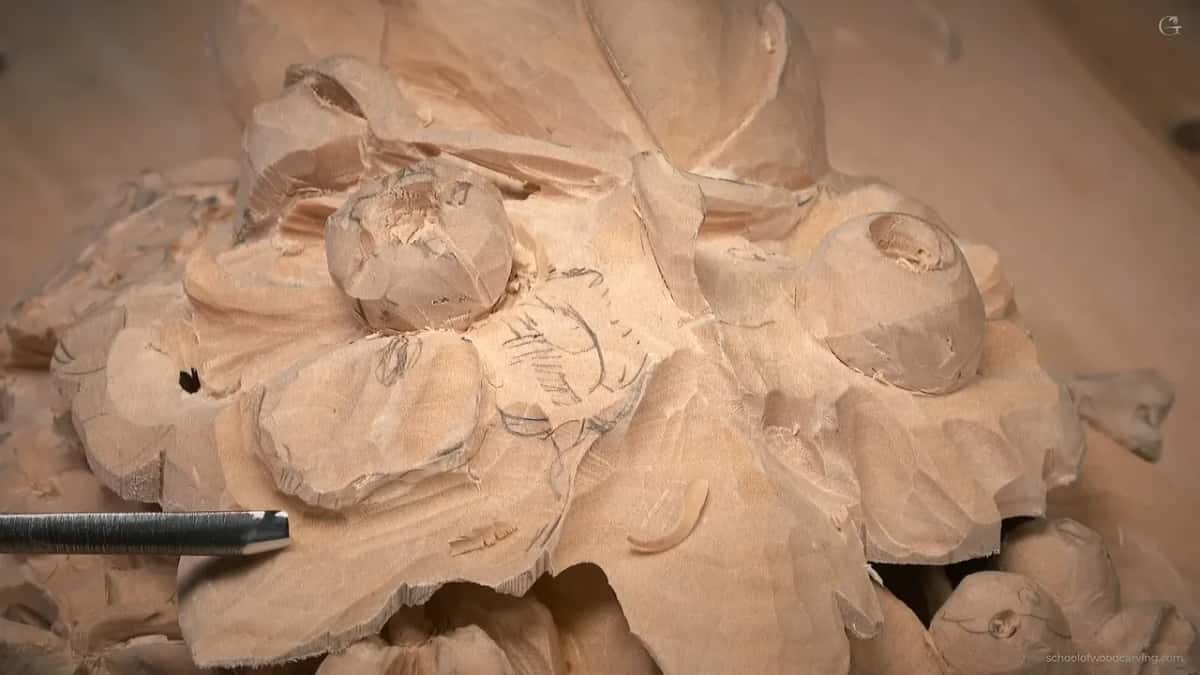
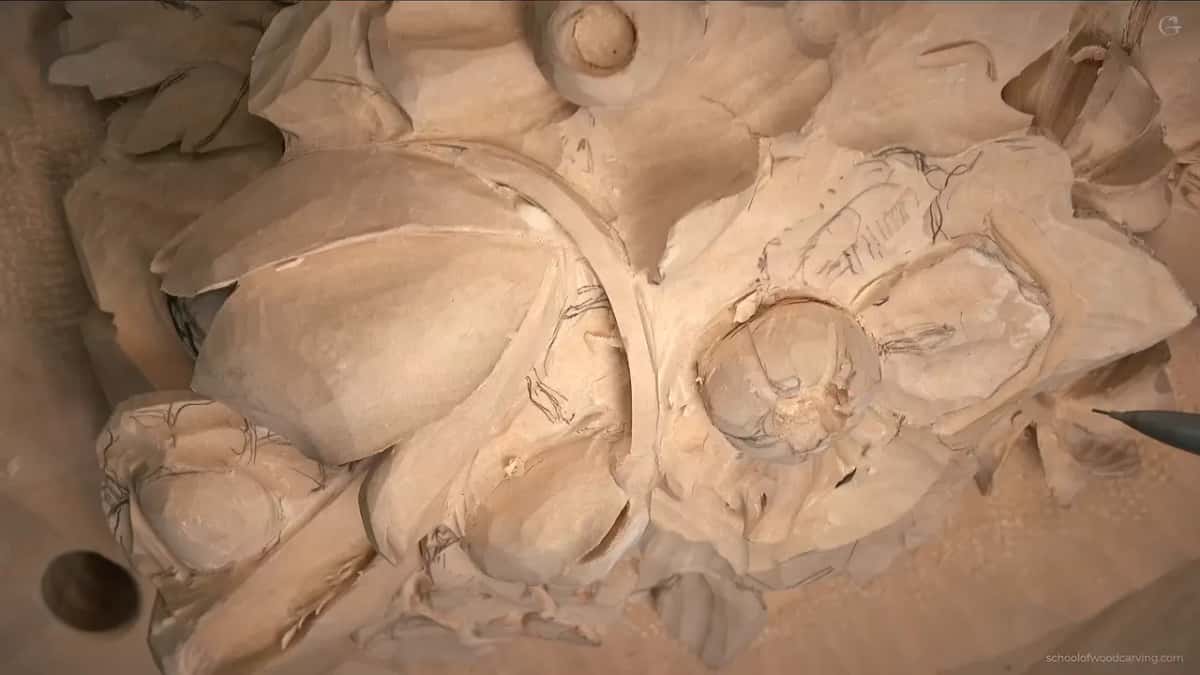
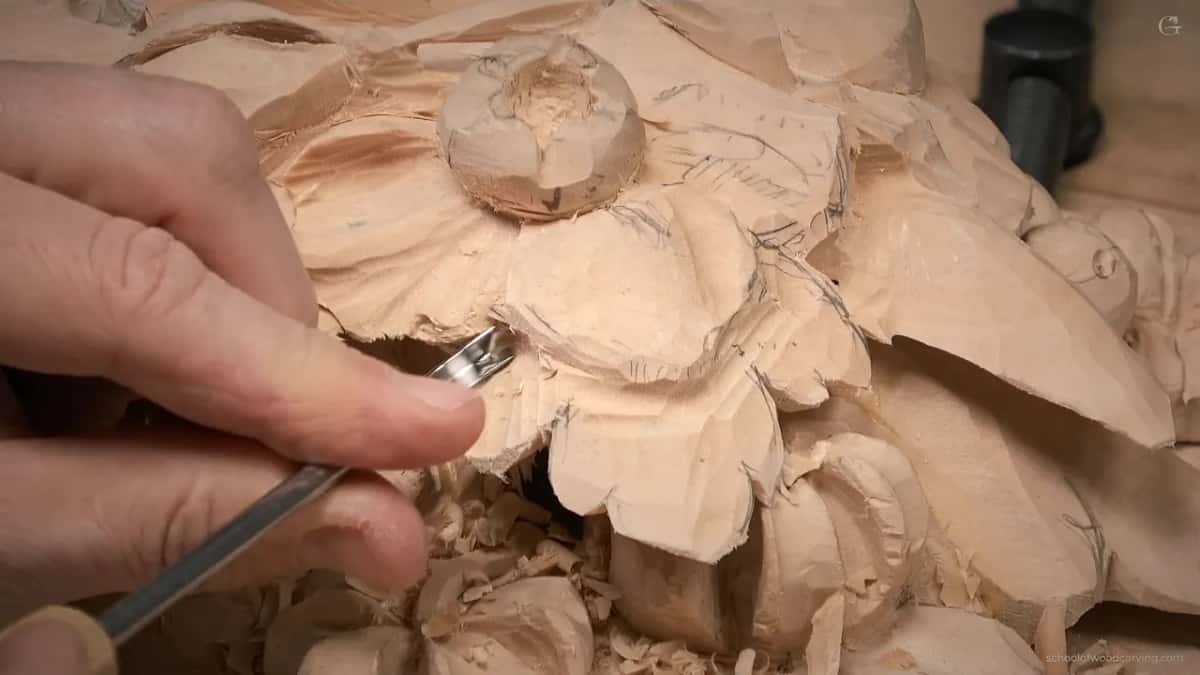
It warned me. I was working around and underneath a petal with very little material, checking right below it, and there was just not much. When I put a finger under it, I didn't have too much material. I don't see the other side, I said, but I could see one of the parts becoming somewhat darker. Almost translucent. That means if I keep digging, I'll make a big mistake.
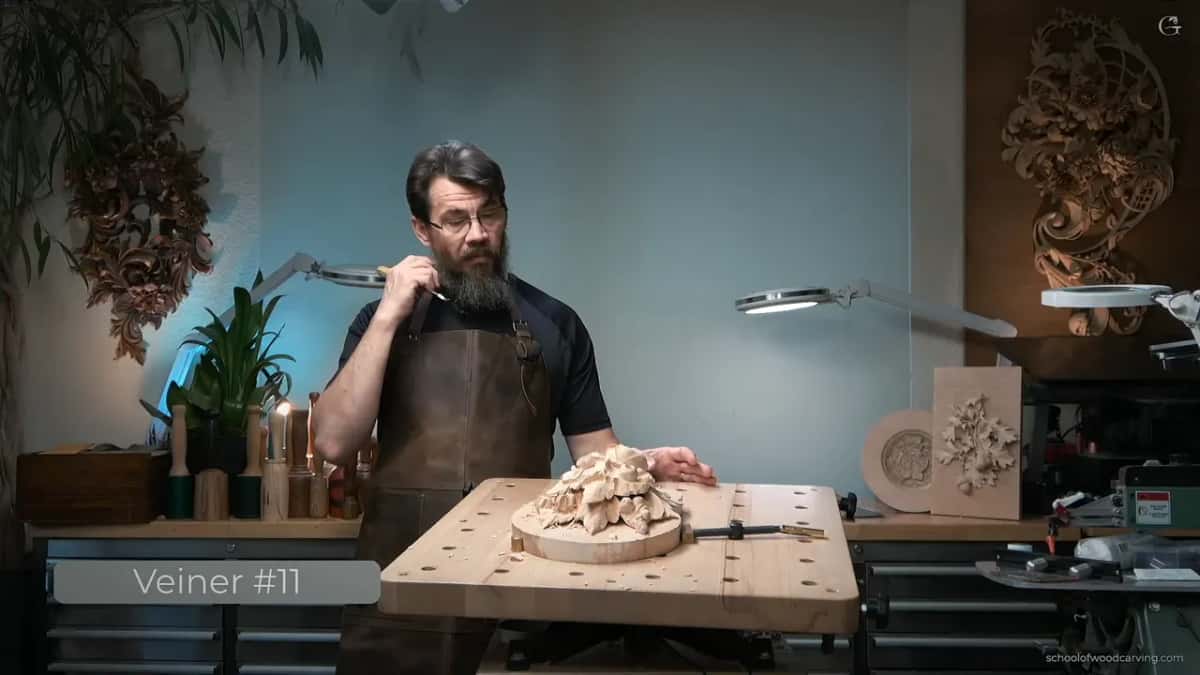
Nothing in these classes names the species of our boards, so I won't. We started with two pieces of 2 inch (51 mm) stock and one of 1 inch (25 mm) for the background, back in class 1.
Later in the same video I got even closer. See how close I got to the opposite side, I said. It's just like 1/16 of an inch, about 1.6 mm, and some spots like one millimeter (0.04 in). I didn't need that part, so I left it open to excavate.
The first hole came before that, and I called it absolutely fine. That way I'll know exactly the depth. What I gained by it you don't really see unless you look from the side.
How do you dig under a petal that thin?
Little by little. In part two I found about 10 millimeters (3/8 in) of material on one petal, somewhat angled, which is why you don't really see it. That meant I could excavate deeper and make a really big shadow, like a leaf growing from slightly below.
For outlines in part one I used a small skew, about 6 millimeters, a quarter inch, held upside down with the sharp point going down. Is that the proper tool? The skew chisel used to be a big deal in the 17th and 18th century, I said, a common tool in wood carving and also in wood turning.
I dug with a number 8, about 5 millimeters (3/16 in), an early Marples. I kind of like it. Under the edge I went to a spoon, still a number 11, 4 millimeters (5/32 in).
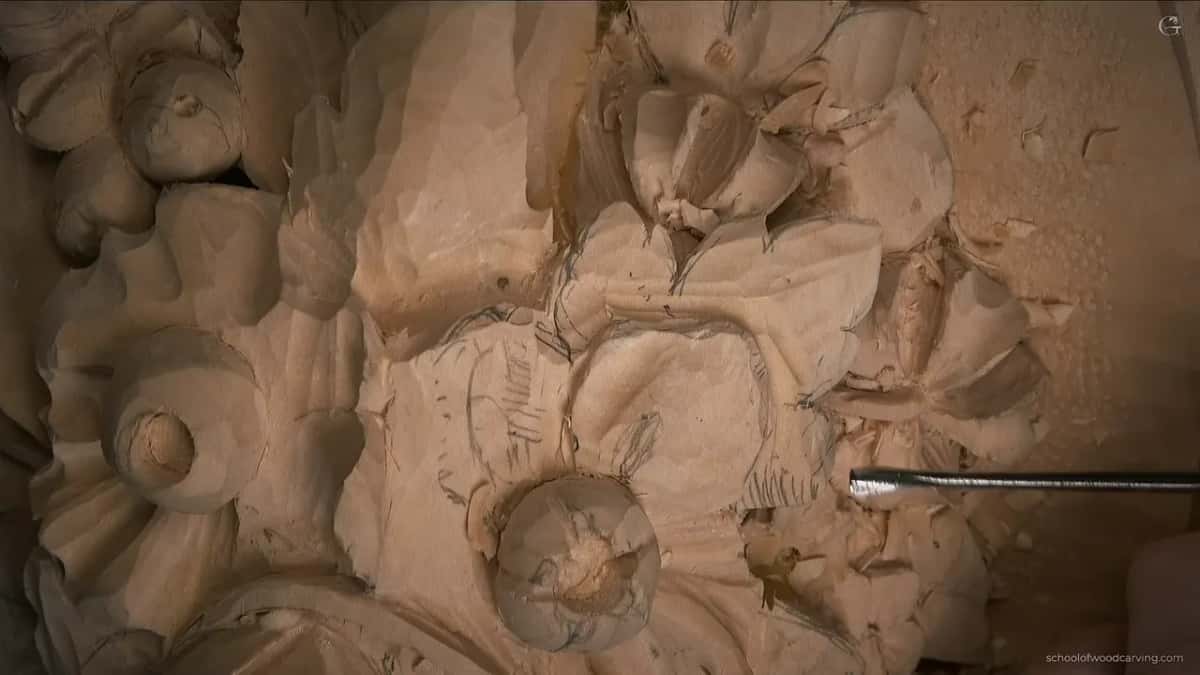
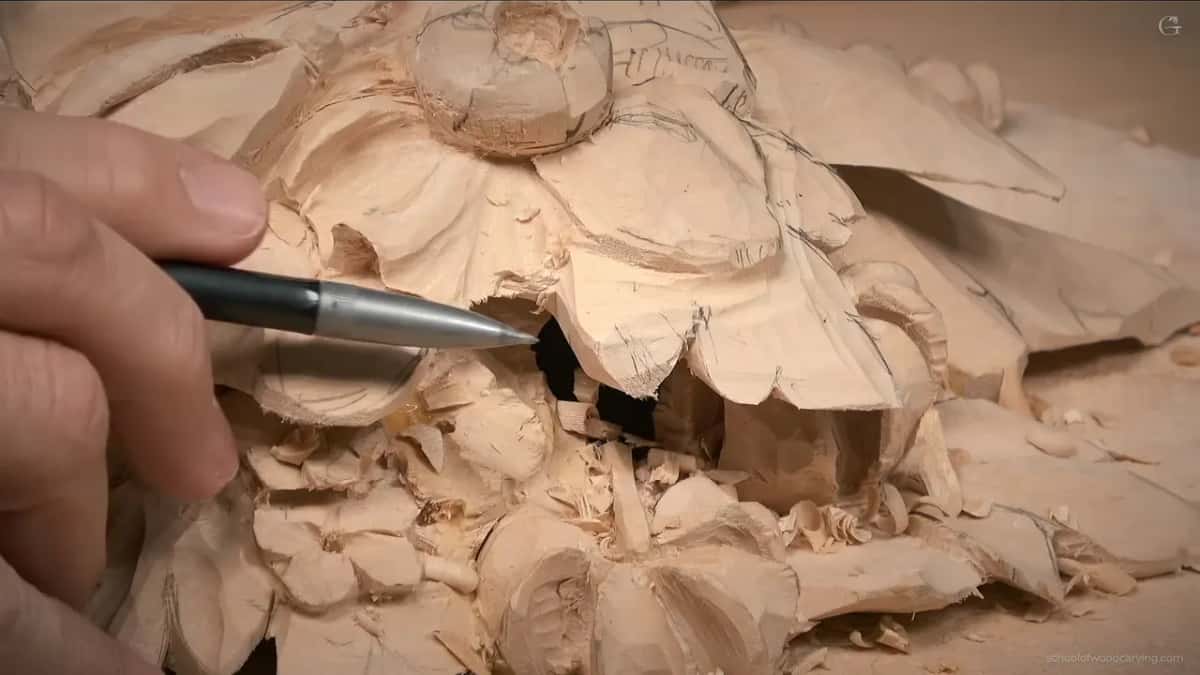
I don't know how deep I can excavate. That is why I'm not taking too much material at once, just little chunks, little by little. Even so I got a hole inside, one you can't see from above. That was my stopping point. The hole sat somewhat in the right position, so it should not be a problem, I said.
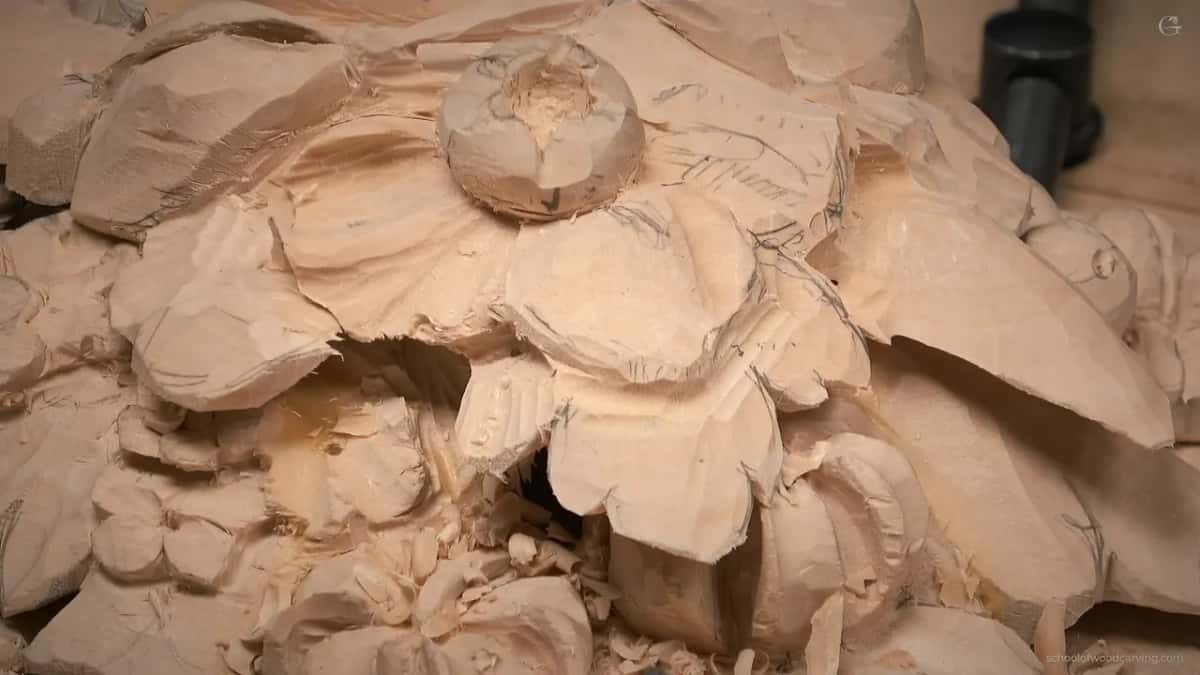
Soon after, another spot went paper thin. I did create the problem, I said, though it's not a big problem. With a number 11 on the next petal, I said I'm not going to force it. A spoon might work better in this case, because I was attacking from the bottom. But it's okay, I said, and I went on to the edge.
Before that, I said the edge of that petal would go up, then down, then the middle part raised, then down, and up again at the other end. I'm more on the extreme side with those waves, because I think it looks more natural.
Which way does the grain run in Gibbons style work?
You can't follow it. In a Q and A on carving with the grain I said that when you carve in Grinling Gibbons style, there's no such thing as carving with the grain. Absolutely no. You have to attack from some angles, and the only solution is to keep your tools sharp.
Wikipedia's Tilia page says linden timber is soft, easily worked, with very little grain. In class 10 I took the number 16 V tool under one spot, then came at the petal from the opposite direction, flute to the left, and it went right underneath for a really deep undercut. It's a 35 degree angle, an antique one. You don't have to have antique tools, I said, and you can buy a Swiss made number 16.
What do you do when the wood breaks through?
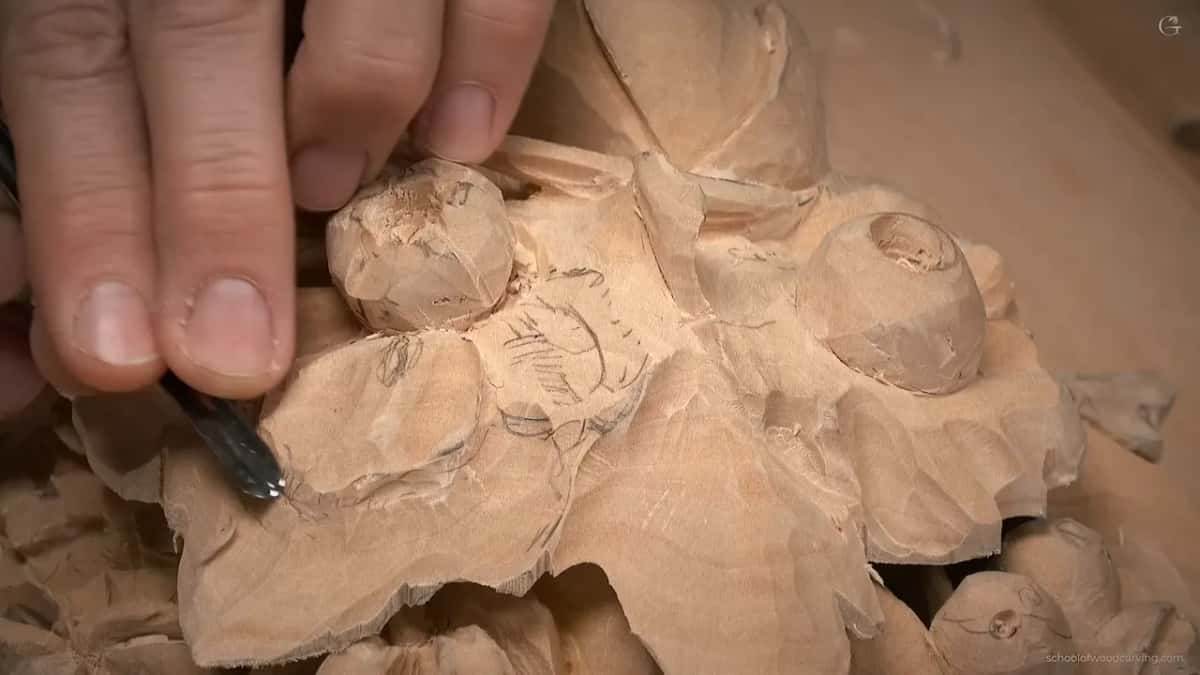
Change the design. A hole turned up in each of the three parts of class 10. Early in part one a leaf already had a hole, and I took advantage of it to separate that leaf into three. In part three the holes made me think one leaf could become two and still look nice.
If you break something, you always have an excuse to change the design. Why that makes me prefer an original piece to a replica is quoted on the class 1 page.
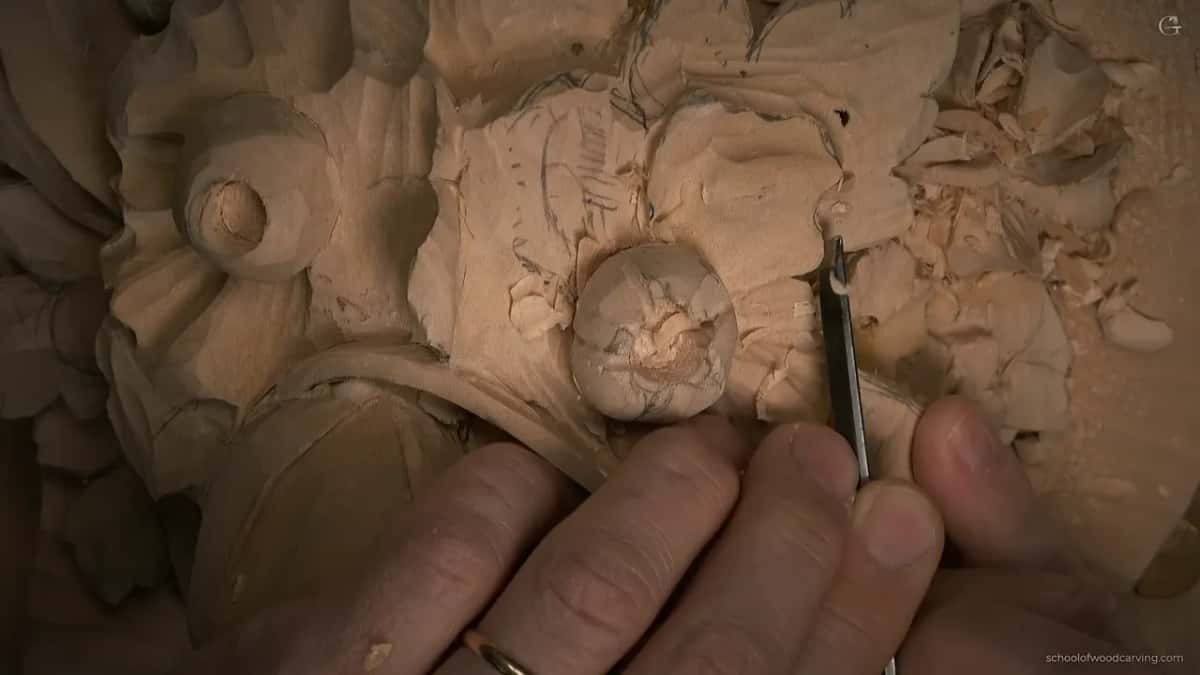
The last hole showed me the stem of a flower right below. Maybe it's a good thing, I said, but it's kind of a weak spot, because there's nothing to hold on. It looked like I was pushing too much, so I stopped on that side.
My first thought was some kind of glue right underneath. Sometimes, I said, Grinling Gibbons would stick something right underneath, in the opening, and support it with another piece. My plan, I said, was probably to carve a small detail and put it in there. For now it got a small amount of glue.
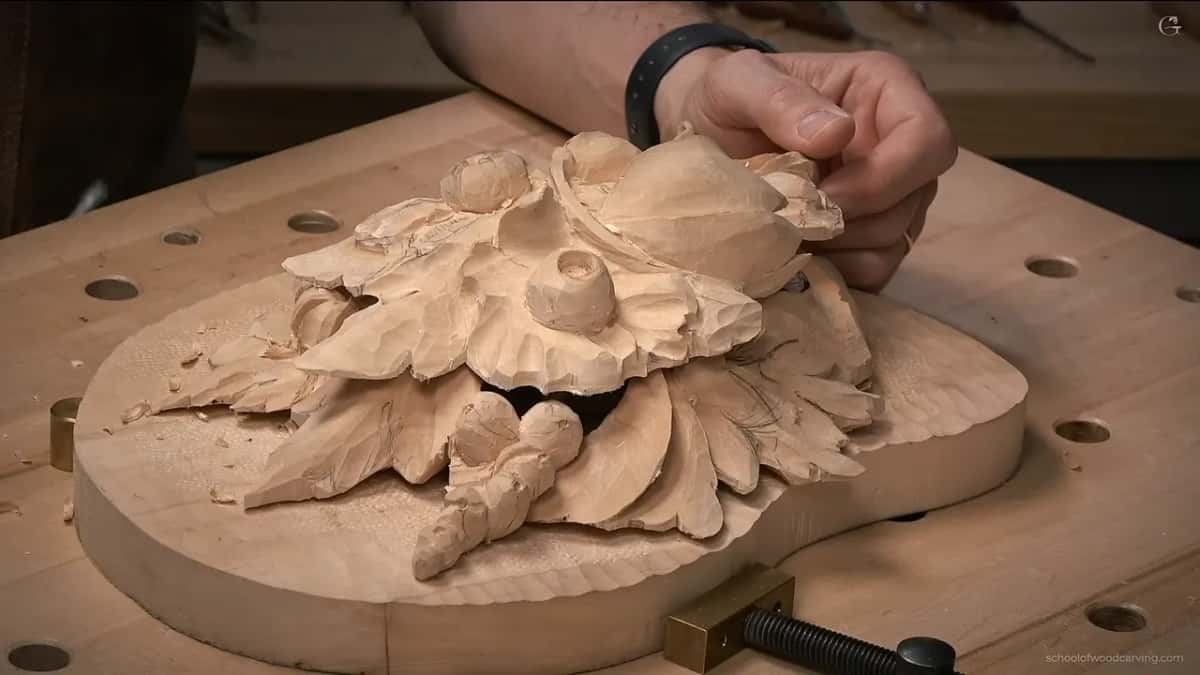
Opening that section showed me some filler flowers, and it gave me a chance to connect the two pancakes, the two layers that still look stacked from the side.
Did Gibbons put a finish on his limewood?
Never, the way I tell it. Back in that Venice Room lesson I said he did not apply any wax or shellac. He left just the bare wood. Carvers who worked in oak, most of the time, put on beeswax, and shellac later on. Go and look at both today. Without any finish, 300 years later, his still looks beautiful.
That is my own opinion, and it's controversial, but I think you see a lot more aging on oak than on limewood. I've got pieces of my own I carved about 10 years ago with no finish, and the color just develops naturally. It's really beautiful.
On a floral panel I said he did use sanding, with reed rush in place of sandpaper, about equal to 400 grit.
It was a nice class in Maine, by the way, with beautiful weather and a beautiful group of people.
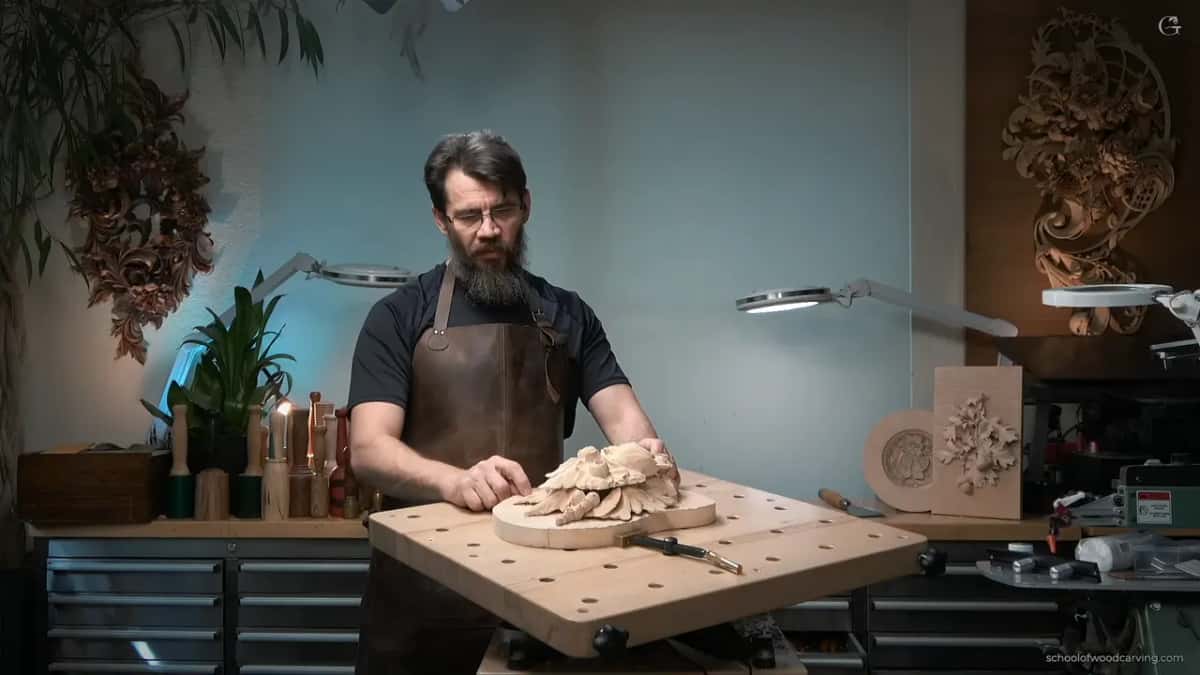
Want to see the dark board go behind our flowers? It happens by class 17. Every Maine class is on the course page, and Tuition opens all of them, the holes included.
How it's done
- Carve the flowers in limewood or basswood. Gibbons used limewood. In the USA the same kind of wood is sold as basswood.
- Plan a darker board for the back. His was oak. Cherry would do, and on the Maine panel I went with walnut.
- Check underneath with a finger. Before you take more, feel how much material is left below the petal.
- Stop when the wood goes darker. A part turning somewhat darker and almost translucent means one more pass is a big mistake.
- Take little chunks. You won't know how deep you can go, so take a bit, look, take a bit more, and don't force the tool.
- Keep the edges sharp. This style won't let you follow the grain, so keep a sharp tool, the only solution I know.
Frequently asked questions
Is basswood the same wood as limewood?
Close enough that I treat them as one carving wood. Basswood is the American name, limewood the British one, linden the German and lipa the Russian. Botanists still split them into species of one genus, Tilia, so American basswood and the small leaved lime of Britain are cousins.
Why did Gibbons set his carvings on oak?
A darker board behind pale carving gives contrast and exaggerates every excavated area. I said that in class 17 about the walnut behind our Maine panel, where I also said his was oak. Cherry is another dark choice I've named.
Why call limewood the queen of woods?
My own name for it, and only my opinion, said on a Venetian piece. One of the best woods for carving, I said, a beautiful wood that carves easily and holds form. For furniture used every day it's not the best, but for big pieces or a hobby there's no better wood.
What to carve next